In most explosions, the injuries come from glass rather than from the blast itself. A pane that turns into a thousand fast shards does more damage than the pressure wave that broke it.
Blast retention film is built for that exact moment. Here is what it does, how it differs from ordinary safety film, and what a Toronto building actually needs.
What blast retention film is
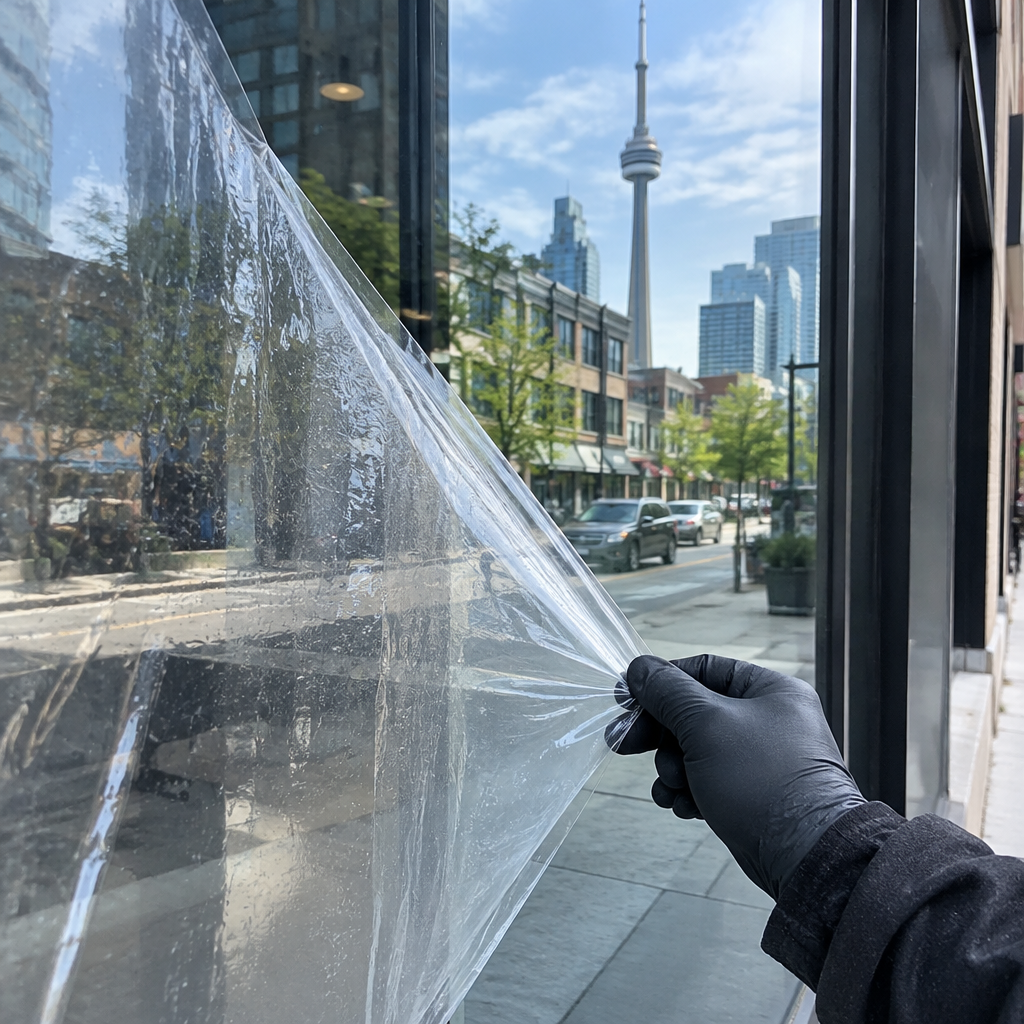
It is a heavy gauge polyester film, typically in the 8 to 15 mil range, laminated in multiple layers and bonded to the inside of the glass. Standard safety film is the same idea at a lower thickness.
The film is only half the system. It has to be anchored into the frame, either with a structural silicone wet glaze at the perimeter or by tucking the edge into the glazing channel. An unanchored sheet holds the glass together and then leaves the frame as one heavy piece, which is worse than a thousand small ones.
How it behaves when glass breaks
The glass cracks. The film stretches and holds the fragments in a web, attached to the frame. The opening stays closed, the shards stay on the film instead of crossing the lobby, and the building envelope survives long enough for people to leave.
That is the whole job: fewer injuries, and a building that still has walls. Blast film does not stop a vehicle bomb. It reduces what the glass does to the people standing behind it.
Blast film versus standard safety film
- Thickness. Blast rated film is several times heavier than a 4 to 8 mil safety film.
- Anchoring. Blast work is always mechanically attached or wet glazed. Light duty safety film is sometimes installed without either, which we do not recommend.
- Overlap and detailing. Blast installs use overlapped edges and a continuous perimeter bead, because a gap is where the failure starts.
- Specification. Blast jobs are specified against a threat level and a glass type, not chosen from a sample card.
Which Toronto buildings actually need it
Ground floor glass in high traffic locations is the first answer. Lobbies, bank branches, government service counters, transit entrances and any glass wall facing a busy street.
Institutional and critical facilities come next: schools, hospitals, data centres, utility buildings. Not because anyone expects an attack, but because the same film that resists a blast also handles a gas leak or an accident at the intersection outside.
Glass above occupied space. A failed sealed unit six floors up drops glass on a sidewalk. Blast and safety film keeps that panel in its frame instead.
Buildings next to construction or demolition, where vibration and impact are a daily reality rather than a hypothetical.
How a project runs
We survey the glass, note the frame type and the size of each panel, and specify film and anchoring per opening. Every pane is measured, not estimated, because a blast system is only as strong as its worst perimeter.
Installation happens after hours in stages, one elevation at a time, so the lobby or the branch is never fully out of service.
Cure takes a few weeks on a heavy film. The glass reads slightly darker from outside during that period and settles afterwards.
What it costs
Blast retention is quoted per project. Film, anchoring, height and access all move the number, and any honest square foot price for this work would be a guess.
For scale, frosted and privacy film on the same glass runs $7 to $10 per square foot, and standard solar film is in a similar band. Blast rated systems sit well above that, because the material and the anchoring are a different category of work.
What the rules require
Ontario does not license film on commercial glass, but two requirements always apply. Exit signs and egress paths stay visible, and film cannot cover a required vision panel. On a leased floor, the landlord or condo corporation also has a say in how the glass reads from the street.
On a vehicle the rules are separate and specific: rear doors and rear glass can go to 5%, the front doors have to keep the driver clearly visible with 35% installed up front, and the windshield stays clear.
Frequently asked questions
Does blast film make glass bomb proof?
No, and no film does. It reduces injury from flying glass and keeps the opening closed, which is what building safety standards ask for.
Can it go on existing glass without replacing it?
Usually yes, and that is the point. Retrofit film is how an older curtain wall gets brought up to a better standard without a glazing project.
Will it change the look of the building?
Clear blast film is nearly invisible. It adds a slight sheen at an angle and nothing else.
How long does the warranty run?
Quality blast film carries a ten year or longer warranty on adhesion and clarity, and we hand over the documentation for your building file.
If you manage glass that people stand behind, call 437-331-5379 or send photos through our contact page. We install safety and security window film across Toronto and the GTA, and commercial window tinting for the rest of the building. Property managers can start with our trade partner program, or read the safety film overview first.
Blast retention
The glass cracks, the film holds, the opening stays closed long enough to get everyone out.